Walking as a Way of Seeing the Strange
A short neighborhood walk, paired with Surrealist habits of attention, can surface odd images worth keeping, though the evidence supports it as a practice to test rather than a guaranteed method.
Marin Vale · October 29, 2026
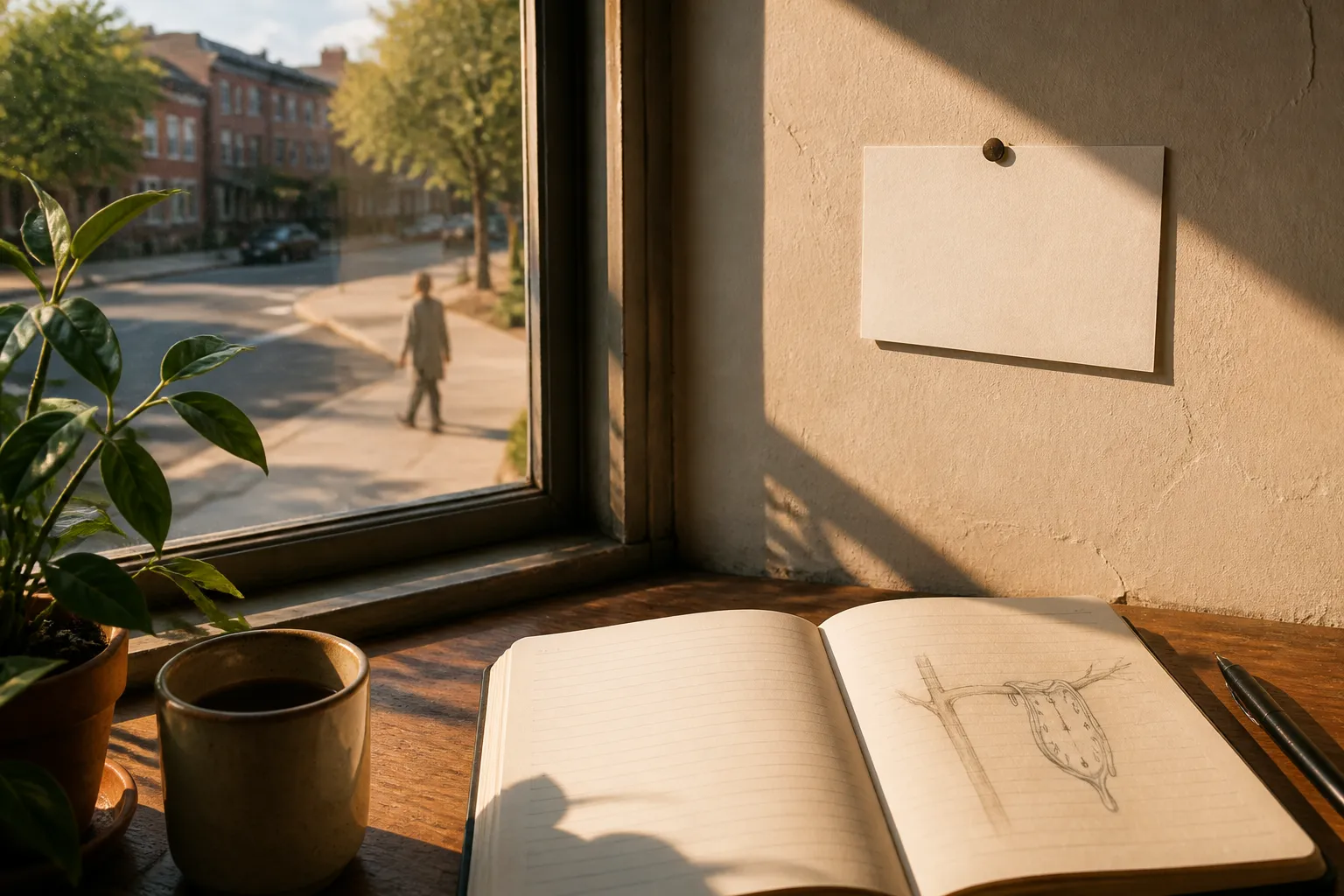
Some prompts ask for more effort. This one asks for better noticing. A short walk through a neighborhood can do that, and the research gives it a practical edge. In a 2014 Stanford study by Marily Oppezzo and Daniel Schwartz, walking improved divergent thinking during the walk and shortly after. The point is not that sidewalks are magic. The point is that motion seems to loosen the mind just enough to let odd details surface.
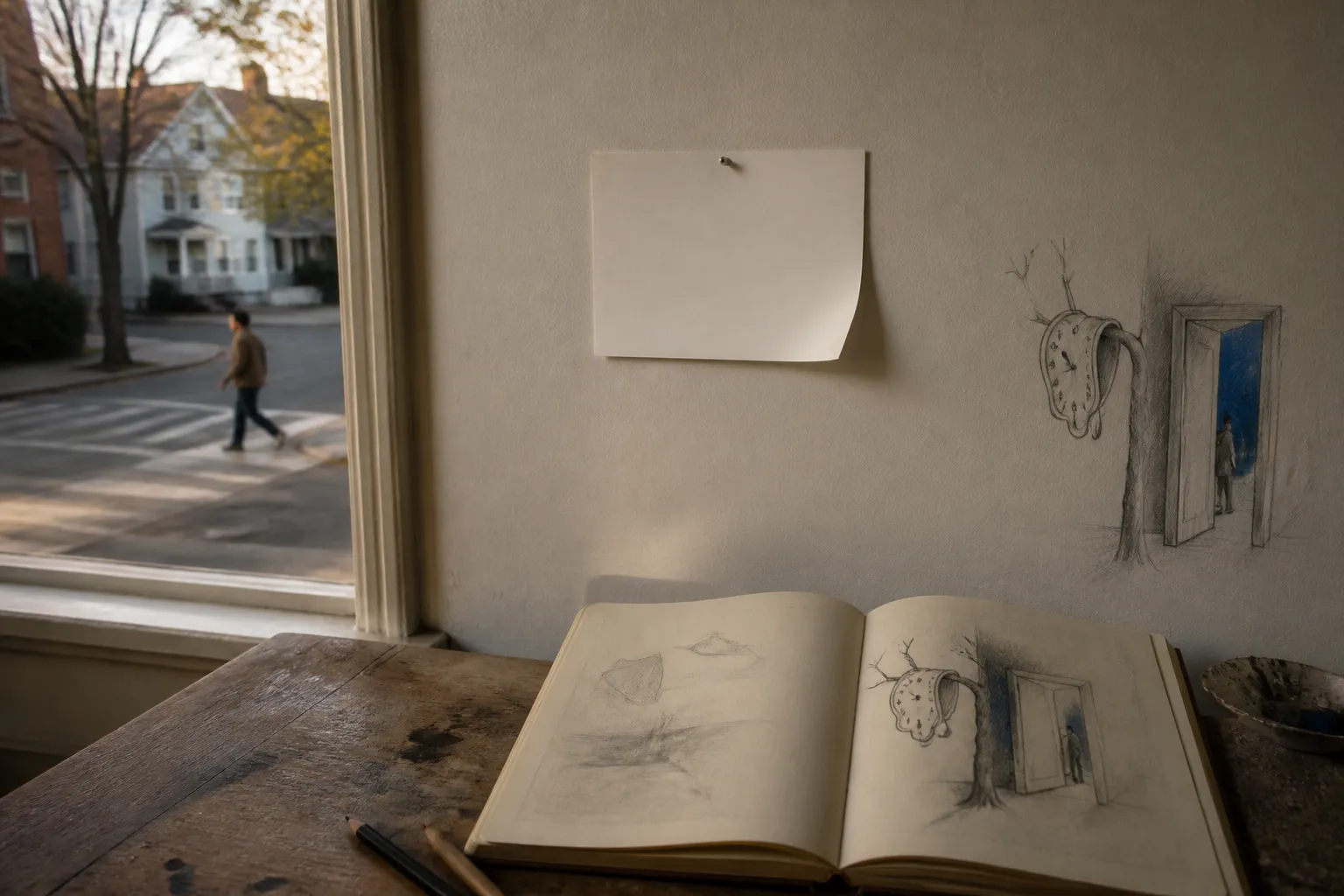
Why walking comes first
The strongest version of the finding is not about scenery. It is about walking itself. The Stanford work ran four experiments with 176 college students and other adults, and the effect held up even when the walking happened indoors on a treadmill. People pushed in wheelchairs did not show the same boost, which is a useful clue. The movement matters more than the view.
That matters for prompt design. If the task is to generate many possibilities, walking is a good starting frame. If the task needs one exact answer, the walk is less useful on its own. This series is built for open-ended idea generation, not for solving a single puzzle. That distinction keeps the exercise honest.
There is also a caution buried in the numbers. Many write-ups repeat the same figures, including the claim that output rose by about 60 percent and that 81 percent of participants improved. Those numbers come from the divergent-thinking tests, where people listed different uses for objects in four minutes. They do not automatically transfer to every creative task. They should be treated as a signal, not a guarantee.
The Surrealist part of the brief
Surrealism offers the second half of the method. André Breton's 1924 manifesto defined Surrealism as pure psychic automatism, and many Surrealists used automatic drawing or writing to reach images that felt less edited, less polite, and more charged. They were drawn to the uncanny, the disregarded, and the unconventional. A cracked step or a faded shop sign can do that work if the observer is willing to take it seriously for a moment.
This is where the walk becomes more than a fitness cue. It becomes a collector's pass for stray images. A drainpipe can become a speaking tube. A broken curb can become a mouth. A laundromat window can hold two weather systems at once, one inside, one outside. The point is not to force strangeness onto the street. It is to notice how often the street already offers it.
The sources do not give a direct method for turning neighborhood observations into surreal scenes. That gap matters. The seven-day structure below is an editorial bridge, not a research finding. It borrows the looseness of walking and the image-first bias of Surrealist practice, then asks them to work together in small, testable steps.
How the seven days can work
The cleanest rhythm is simple. Walk, observe, record, then sit and shape. The walk is for gathering. The sitting step is for choosing. Research suggests that movement supports open-ended ideation, while a seated pause can help when one precise image needs to be selected. That split keeps the exercise from turning into a blurry notebook dump.
Day by day, the prompt set can move from looking, to pairing, to distortion, to scene-building. One day might ask for three overlooked objects. Another might ask for a public surface that seems to remember something. Another could push a detail into a wrong-sized version of itself. The series should stay close to the street, though, because ordinary settings supply the best friction. A prompt that starts with a fire escape or a stoop has something solid to bend.
Recording in the same session helps. The Stanford study points to ideas arriving during walking and shortly after, so there is no reason to wait until later and hope memory does the rest. A phone note, a pocket notebook, or a voice memo all work if they are quick. The trick is to keep the image fresh enough that its oddness has not been flattened by hindsight.
What to watch for on the street
Not every detail deserves the same attention. The useful ones are often the near-misses, the things that seem too small for notice until they carry a little tension. A bent fence slat. A plastic chair left in rain. A security sticker on a blank storefront. These are not grand subjects. That is why they work. Surreal images often begin where ordinary attention usually stops.
One reliable method is to ask what the object might secretly want. Another is to ask what it would look like if it had been left in the neighborhood for too long, as if the weather had been talking to it. This is a prompt design choice, not a claim about psychology. It gives the observer a way to move from description to scene without reaching for a full story too soon.
That restraint helps the series stay sharp. If every walk becomes a mini fiction workshop, the details can blur. Better to limit each day to one or two observations and one transformation rule. One object, one distortion, one image. The result is more likely to feel concrete and strange at the same time, which is usually the point.
A practical caution for makers
The available studies say useful things about idea generation, but they leave out several parts of a real-world prompt series. They do not cover safety, access, route choice, or what happens when a neighborhood is unfamiliar or uncomfortable to walk. They also do not tell us whether these effects carry over to visual art output or AI art prompts. Those are live questions, not solved ones.
That is why the prompt series should be framed as a tool for testing, not a promise. Ask whether the task calls for many possibilities or one decision. Ask whether the user can walk and record in the same session. Ask whether the route is ordinary enough to produce details but stable enough to revisit. These are small questions, but they shape the quality of the work.
Used well, the series does not turn a neighborhood into a fantasy set. It does something more modest and more useful. It teaches the eye to catch the strange edge of the familiar, then gives the hand a way to keep it.
Sources
- Study: Walking Increases Creative Output By 60% | Wellable
- Taking a Walk Will Boost Your Creativity and Problem-Solving | Psychology Today
- Boost Creative Thinking With a Walk, New Study Says
- Give your Ideas some Legs! - Jane Fisher Associates
- Stanford study finds walking improves creativity
- Walking helps get the creative juices flowing, new study finds | Stanford Graduate School of Education
- Surrealism | Tate
- https://colognegamelab.de/wp-content/uploads/2024/02/02_TATE_Surrealism.pdf